
516 pull requests, 264 opened by agents: how Spunto builds Spunto
The home page says we build Spunto inside Spunto. Here are the counted numbers, what an agent's pull request has to carry before I read it, the agents that start themselves every morning, and the CI I switched off.

Mathieu
Founder, Spunto
The Spunto home page makes one claim it can't illustrate with a screenshot: we work in it. Spunto runs sandboxes for coding agents, and the platform itself — API, dashboard, sandbox runtime, the page you're reading — is mostly written by agents running in those sandboxes.
That's an easy sentence to write and a hard one to check, so this post is the check: the numbers, how they're counted, and the process that makes an agent's pull request something I can actually merge. That includes the parts I tried and dropped.
An agent pull request here is one whose branch was opened by a Spunto sandbox with nobody at the keyboard: task/… for native tasks, notion/… for the pipeline that came before them. Counted with gh on November 6, 2026:
| Repository | What it is | Merged PRs | Opened by an agent |
|---|---|---|---|
| Spunto Cloud | this platform | 516 | 264 |
| Spunto CMS | a Notion-style workspace | 97 | 76 |
| Spunto Search | an Elasticsearch-compatible engine in Rust | 57 | 44 |
| Spunto Lite | the self-hosted, one-container edition | 57 | 33 |
| Total | 727 | 417 |
for r in coderhammer/spunto spuntodotnet/search \
         spuntodotnet/spunto-cms spuntodotnet/spunto-lite; do
  gh pr list -R $r --state merged --limit 2000 --json headRefName \
    -q "[length, ([.[]|select(.headRefName|test(\"^(notion|task)/\"))]|length)]"
done
On Spunto Cloud, that's a bit over half. And that half undercounts. The other branches (fix/…, feat/…, design-system/…) weren't typed by hand either. They come from sessions where I sat in front of Claude Code inside a sandbox and steered it, instead of handing it a prompt and walking away. The commit trailers say so:
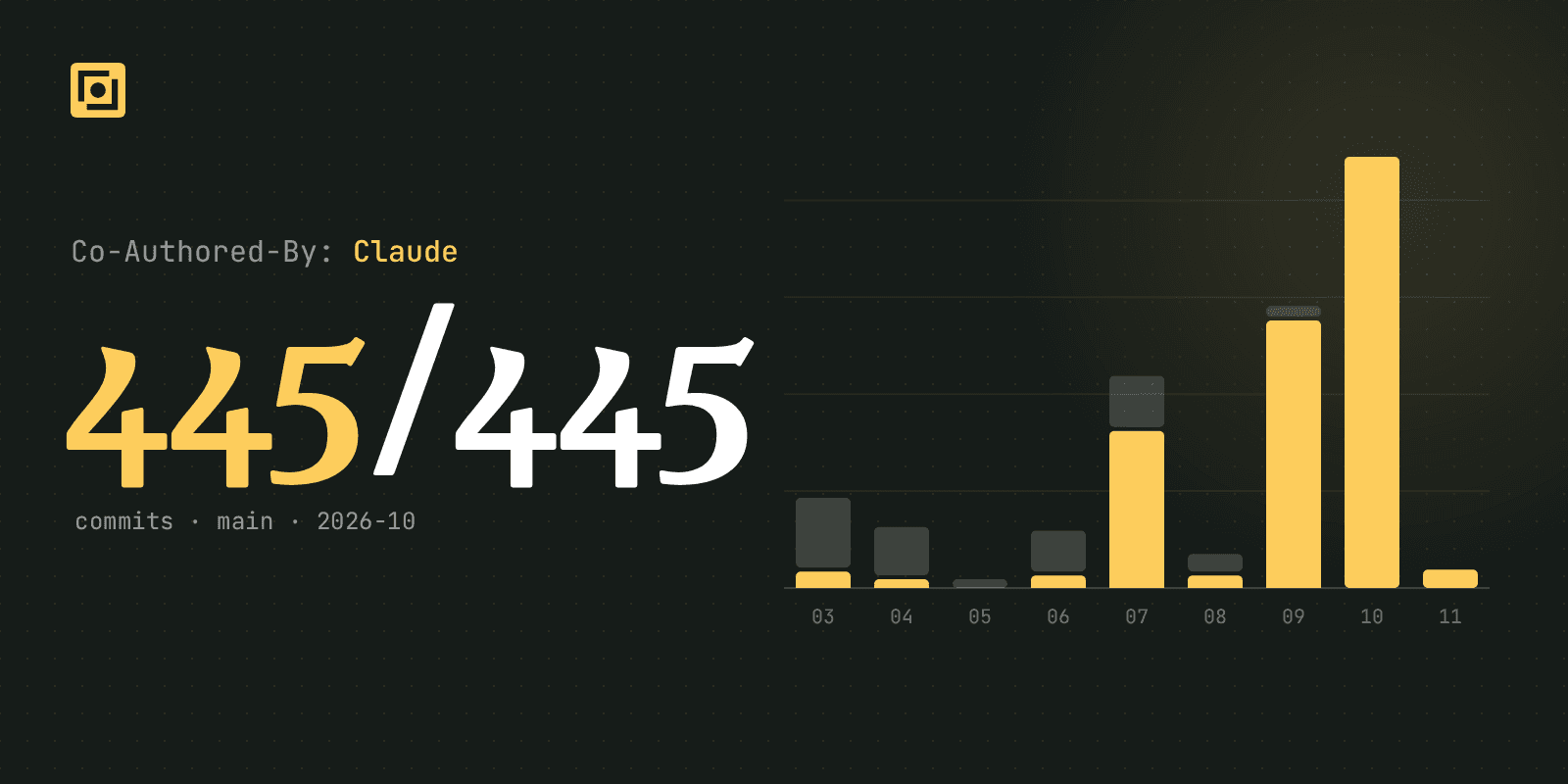
Out of 1,209 commits on main, 954 carry a Co-Authored-By: Claude line. Since September it's nearly all of them, and in October it was every single one: 445 out of 445. So the branch prefix doesn't tell you who wrote the code, which is Claude either way. It tells you whether I was there while it happened. That's the line worth measuring: everything to the left of it costs my attention while the work happens, everything to the right only when I read the result.
The way work reaches an agent changed three times, and each change moved a piece of glue from outside the product into it.
- ClickUp, July 5–7 (13 PRs). Moving a card to a column started a disposable machine with the card's text as its prompt. It worked for three days, long enough to show the idea held.
- Notion cards, July 8 – September 9 (72 PRs). Same idea, better board. A card moved to running, an automation created a disposable machine on branch
notion/<card>, and the agent followed a procedure file in the repo: implement, reset the environment, test end to end, record a video, attach it to the card, open the PR. The automation only created and stopped the machine; everything in between was the agent. - Native tasks, since September 8 (192 PRs). A task is now a thing in the product: a prompt and a project, a sandbox of its own, a session you can read while it runs, and two buttons at the end, Accept and Drop. Nothing outside Spunto holds the loop anymore.
Since October 31, Spunto doesn't even create the branch: a task starts on a clean checkout and the agent names its own branch if it wants one. A task doesn't need a repository at all.
When I start a task on the Spunto project, the platform starts a sandbox from the project's devcontainer: the same recipe a human gets when they open one by hand. By the time the agent's first turn begins, postCreate has installed dependencies, run the migrations and seeded the database, and postStart has brought up the whole stack: Postgres, the API, the dashboard, a test desktop with Chrome on demand. The agent works on a running copy of Spunto, inside a box Spunto started. That inception is what makes the rest possible: an agent that can't run the thing it's changing can only guess.
The session streams into the task page as it runs, in Spunto's own event vocabulary whatever the harness (Claude Code, Codex and Mistral Vibe today). When the agent's turn ends, the task goes to in review. I answer in the same conversation, and the session picks up where it was. When it's right, I accept; when it isn't, I drop it, and the sandbox goes away either way.
Agents write plausible code very quickly. The bottleneck is how fast I can believe it, so the rules in the repository are all about evidence.
A clean environment, not an accumulated one. Before validating anything, the agent reruns ./reset.sh: wipe the database, rerun init and the seed, bring the stack back up. Whatever it tested, it tested from the state a reviewer starts from.
The real flow, played to the end. A UI change gets clicked through in the test desktop's Chrome. A change to how sandboxes or tasks live gets a real sandbox started and driven all the way, even if that's slow. A sandbox that never reaches running doesn't count as tested.
The specs the diff touches, with their raw output pasted on the PR. A script, e2e/affected.mjs, reads the diff and picks the Playwright specs it exercises: no "run everything to be safe", no hand-picked subset. The agent runs them and pastes the raw output. I read the output before I read the code.
Context it can find on its own. Every session starts from zero. CLAUDE.md is an index; the detail lives in 45 topic files under docs/ and 56 RFCs under rfc/. When an agent learns a gotcha, the rule is to write it in the relevant docs/ file in the same PR, so the next session doesn't pay for it again. The same goes for numbers: every figure the home page quotes lives in one file, next to the command that produced it. This post follows the same rule.
Some tasks are started by a cron rather than by me.
- Errors, every morning at 7. A task reads the last 24 hours of platform errors (5xx with their stack, failed tasks, sandboxes in error) and sorts each one: a code bug, an operations problem, or noise. For code bugs it starts at most three fix tasks a day, each with its own sandbox and its own PR. It never merges, deploys or touches production; the last message of the session is the report I read in the morning.
- Dependencies, every week. It goes through npm advisories and dependabot's PRs, proves each bump (lockfile diff, tests, an HTTP and visual comparison between
mainand the branch), and is the one agent allowed to merge its own PRs. It then checks production and reverts if anything broke. - Backlog refinement. Cards in the backlog get their context, usage data, test plan and rollout plan filled in before anyone implements them. The agent never changes a card's status; that stays a human decision.
On October 28 I stopped running CI on pull requests. Nobody was reading the checks anymore: the evidence that mattered was already on the PR, pasted by the agent from a run against the real stack. Meanwhile, the browser suites took about 47 minutes on our old self-hosted runner, and the same specs run in one to two minutes inside a sandbox, next to the stack they test.
It came back in one place a week later: since November 4, the API end-to-end tests run on every PR that touches the API, each run in its own throwaway Spunto microVM, so it costs no Actions minutes.
I read every PR before it merges, apart from the dependency bumps above. Of the 276 agent PRs on this repository that are no longer open, 12 were closed without merging. That figure flatters the agents: a task I drop never becomes a PR, so the misses mostly die in review, which is where they should.
What I no longer do is type most of the code, or keep the context in my head between sessions. The repository has to hold that context so the next agent can find it.
If you want the same loop on your own code, Spunto Cloud runs the sandboxes: one per task, your devcontainer, your agent, paused for free while you read.
Mathieu
Founder, SpuntoBuilding Spunto — self-hosted dev environments for engineers who want their compute to work for them, not against them.